
What’s the Best Age to Start Piano Lessons? A Fort Wayne Teacher Explains
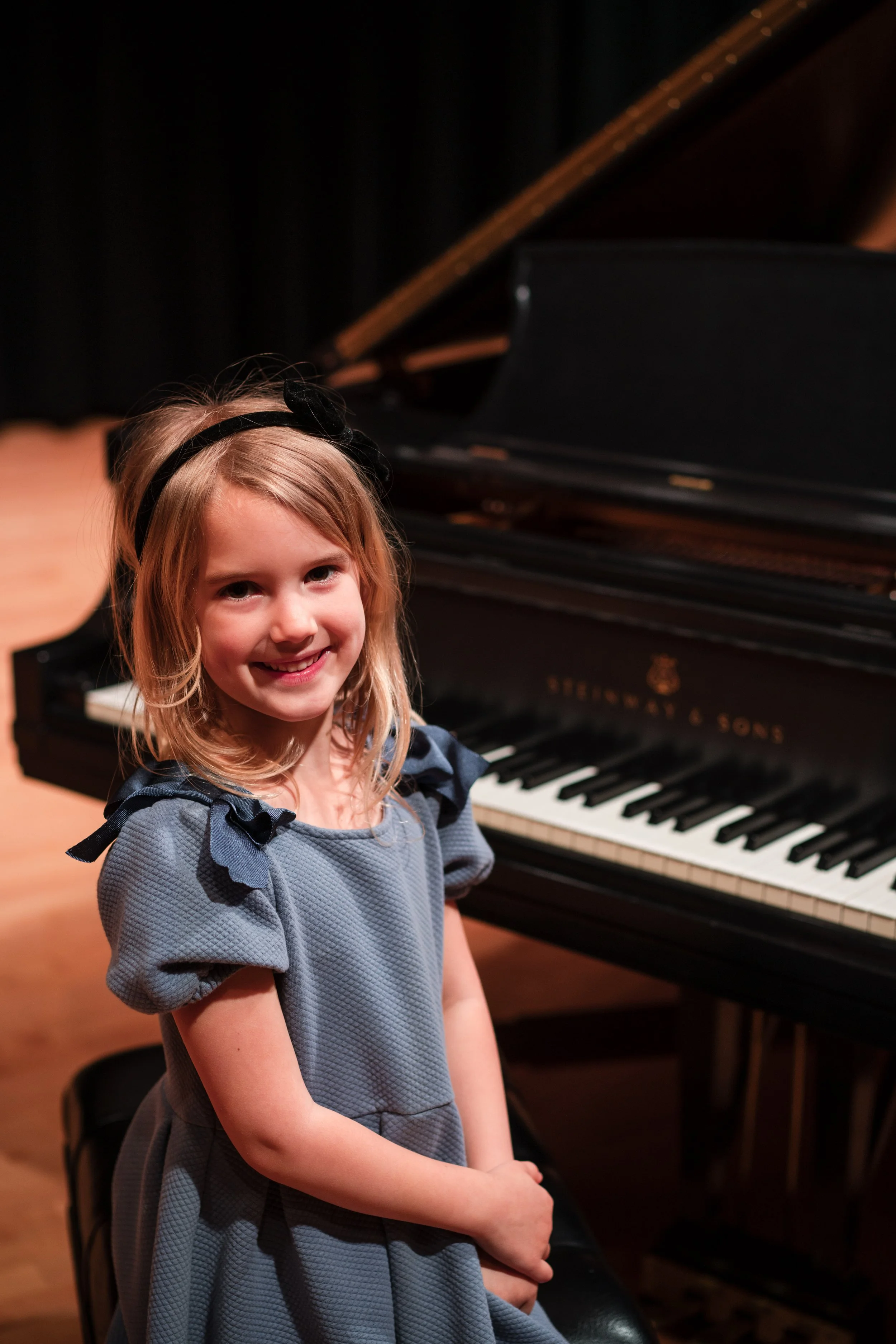
A 4-year-old sits at the piano and proudly finds every C.
A 6-year-old plays two notes, slides off the bench, and announces that he’s starving.
A 5-year-old remembers last week’s song perfectly, but still wants Mom close enough to peek at through the doorway.
And a 3-year-old marches across the room singing a tune no one remembers teaching her.
This is why the question “What’s the best age to start piano lessons?” is both practical and tricky.
Children don’t all become ready for music on the same birthday. Some are ready for real piano lessons at 4 or 5, while others are 6 and still need music to arrive with movement, games, stories, and plenty of room to wiggle.
Both kinds of children can become wonderful musicians. They just need the right beginning.
At Grace’s Piano Studio in Fort Wayne, I don’t look at age alone when I help a parent decide where a child should start. I look at the child. Are they curious? Do they like structure? Do they need to move? Can they be away from a parent? Do they want to learn songs? Do they light up when they hear music?
The best age to start piano lessons depends less on the number and more on the fit, because the goal isn’t just to start piano. The goal is to begin in a way that makes a child want to come back next week!
Music Begins Before Lessons Do
A child’s musical life doesn’t begin on a piano bench.
It begins in the backseat, when a favorite song comes on and suddenly a small voice knows every word. It begins with lullabies, silly songs, church songs, nursery rhymes, clapping games, kitchen dance parties, and the little made-up melodies children sing while they play.
Long before a child can name a note, they’re already learning music.
They’re feeling the beat before they can count it. They’re hearing patterns before they can explain them. They’re learning that music can be exciting, peaceful, funny, dramatic, beautiful, comforting, and full of life.
That’s a wonderful beginning.
So if your child isn’t ready for formal piano lessons yet, you’re not behind. There’s so much you can do before the first lesson ever happens.
Sing in the car. Dance in the kitchen. Clap to music. Play beautiful songs at home. Let music feel like part of ordinary family life.
The piano lesson can come later, but the love of music can start now.
For Little Kids, Play Is Serious Learning
For children through age 5, music should feel like play.
Not because the learning is light, but because play is how young children do some of their best learning.
A preschooler in music class is learning much more than rhythm and finger numbers. They’re also learning how to listen to another adult, take turns, try something new, recover from mistakes, follow a routine, and stay with an activity a little longer than they would on their own.
That’s a lot for a little person!
And it usually happens best through songs, movement, rhythm games, piano exploration, imagination, and short activities that keep changing before the room turns into a parade of wiggles.
A good early music class doesn’t expect a 3- or 4-year-old to act like an 8-year-old with tiny hands. It teaches real musical skills in a way that feels natural to childhood.
Sometimes that means singing. Sometimes it means clapping. Sometimes it means pretending to be animals while learning high and low sounds. Sometimes it means finding groups of black keys like a little piano game. And sometimes it means changing the plan at exactly the right second, because the teacher can feel the class starting to drift.
It may look playful from the outside, but underneath the fun, real learning is happening.
My Petite Pianists program was created for this stage. Children learn rhythm, singing, movement, listening, keyboard patterns, finger numbers, musical opposites, and beginning piano concepts in a way that feels joyful and age-appropriate.
They’re building the foundation for future piano lessons, and they’re having fun while they do it!
The First Goal Is Love
For very young beginners, the first goal isn’t perfect practice. It’s love.
Of course, practice matters. Piano eventually requires repetition, patience, listening, and steady effort. But those habits grow so much better when a child already feels connected to music.
A child who loves music will return to it. They’ll sit down again. They’ll try again. They’ll want to show you what they learned. They’ll begin to feel that music belongs to them, not just to the teacher or the lesson book.
A child who feels pressured too early may decide piano isn’t for them before they’ve really had a chance.
That’s why the first musical experiences matter so much.
A child’s first music class should help them think, “I can do this. I like this. I want to try again.”
That little spark is what we want to protect.
Practice Can Be Wonderful, If It Stays Happy
Preschool practice can help, but it can also become too much, too soon.
A few happy minutes at the piano can be wonderful. A sticker, a tiny prize, a cheerful “show me what you learned,” or a proud little performance for the family can make practice feel exciting.
But forced practice at this age can backfire quickly.
A young child may not understand that a parent is trying to build a habit. They may only feel the pressure, and then piano starts to feel like the hard part of the day instead of the happy part.
For preschoolers, practice should be short, light, and positive. If it feels fun, wonderful. If it turns into a daily battle, it’s usually better to step back.
There will be time later for stronger practice habits. In the beginning, we’re protecting something very important: the child’s relationship with music.
When an Early Music Class Is the Right Fit
A child may be ready for music long before they’re ready for regular piano lessons.
This is the child who loves songs, movement, sound, and rhythm, but still learns best through play. It’s the child who can focus beautifully for a few minutes and then suddenly needs a new activity. It’s the child who is bright, curious, and musical, but not quite ready for a traditional lesson format.
An early music class may be the right fit if your child:
Enjoys singing, dancing, clapping, or moving to music
Learns best through play and imitation
Can focus for a few minutes at a time, even if not predictably
Knows or is beginning to learn the letters A-G
Can count to 5
Is curious about the piano
Needs frequent changes of activity
Is still learning how to be away from a parent
Would enjoy music more with movement, games, and variety
This is what Petite Pianists is for.
It gives young children a real foundation without asking them to grow up too fast. They learn rhythm, listening, finger numbers, keyboard awareness, class skills, and confidence. They learn how to participate. They learn how to try. They learn how music feels in their hands, ears, voices, and bodies.
And because the class is designed for young children, they get to learn all of that in a way that feels fun!
When Regular Piano Lessons Make Sense
A child may be ready for regular piano lessons when they’re beginning to enjoy a little more structure.
Not stiff, silent, perfect structure. Just enough structure to follow a path.
They can work on one skill for a little while. They can listen to a teacher’s direction. They remember some of what happened last week. They want to learn more songs, and they like the idea of doing something that feels a little more grown-up.
A child may be ready for a regular piano program if they:
Can be away from a parent during class, even if the first few weeks take adjustment
Remember some of what they learned from week to week
Can follow simple directions from a teacher
Show interest in learning more songs at the piano
Can focus long enough to work on one skill at a time
Like patterns, books, worksheets, or “big kid” learning
Are ready for more routine
Enjoy the idea of learning new songs every week
Reading helps, but it’s not required.
Children can learn to read music before they can read words. They can learn that notes move up and down, that rhythms have patterns, that fingers have numbers, and that the music on the page connects to what they play on the piano.
It just takes more teacher guidance.
A child who is already reading may be able to move through written music more quickly because they’re used to tracking symbols from left to right, recognizing patterns, and connecting printed information to meaning. A child who isn’t reading yet can still learn those skills, but the teacher usually needs to spend more time building that connection step by step.
That’s why reading is helpful, but not a requirement. A young child can absolutely begin learning real piano skills before they’re reading fluently. We just move at the pace that helps the music make sense.
In my Core Piano Program for kids and teens, students build real piano skills in a structured, encouraging environment. They learn to read music, recognize patterns, build technique, practice efficiently, and become more independent at the piano.
But the heart of the program isn’t just finishing pages in a book. I want students to become quick, confident learners who know how to use music at every level - not just during lessons, but in a way they can enjoy for years.
That’s why we include music students actually love. Favorite songs, familiar melodies, and music that feels exciting to them help students connect their skills to something personal. As they grow, they learn not only how to play the piano, but how to keep learning music they care about.
What About Ages 4 and 5?
Ages 4 and 5 are often where parents feel the least sure.
And honestly, that makes sense. Some children this age are ready for the Core Piano Program, while others still do best with the playful structure of Petite Pianists.
My website lists Core for ages 6-18 because age 6 is a helpful general guideline. But I also have several 5-year-olds in Core right now, and two of them started Core at age 4.
So yes, younger children can be ready! I just don’t assume readiness from age alone. If a child is interested, comfortable separating from a parent, able to follow simple directions, and beginning to remember what they learned from week to week, Core may be a wonderful fit.
If they still need more movement, shorter activities, and playful learning, Petite Pianists may give them a stronger and happier beginning.
School Experience Changes the Picture
One pattern I’ve noticed over the years is that school experience affects piano readiness.
Children who attend preschool often adjust to structured piano lessons earlier. Not because they’re more musical, but because they’ve already practiced the hidden skills lessons require: separating from a parent, listening to another adult, following a routine, participating in a group, and working through small challenges.
Children who begin school in kindergarten, or children who are homeschooled, may need more time to grow into that structure.
That’s not a bad thing. It’s simply a different starting point.
I homeschool my own 3-year-old daughter, and I see this from both sides. In some areas, she’s ready for higher-level learning, which she can experience in the Core program. In other areas, she benefits from Petite Pianists because it gives her practice with class routines, structure, and being with children her age.
That combination fits her right now, and another child might need something completely different.
This is why I don’t believe every child should begin in exactly the same place. The best starting point is the one that fits the child in front of us.
So, What Is the Best Age to Start Piano Lessons?
By age 6, most children are ready for Core Piano.
Some children are ready earlier, especially at 4 or 5. But I don’t usually recommend waiting past age 6 to begin a structured piano program. By that age, children are ready to build strong piano skills with guidance, routine, and music they actually enjoy.
Before age 6, I highly recommend some kind of music program.
The early years are such a rich time for music. Young children are listening, moving, singing, noticing patterns, and building the foundation they’ll use later at the piano. A playful early music class can make the transition into Core smoother, happier, and more natural.
Here’s the easiest way to think about it:
Through age 5: A playful early music and piano class is often the best fit. Children this age usually need movement, variety, imagination, and short activities while they build real musical skills.
Ages 4-5: Some children are ready for Core earlier, especially if they’re interested, comfortable separating from a parent, able to follow simple directions, and beginning to remember what they learned from week to week.
Age 6 and up: Children are ready for Core Piano. At this age, I recommend beginning a structured piano program rather than waiting for some perfect future version of readiness.
Children don’t need to be fully mature, fully independent, or fully reading before they begin learning piano. They need the right teacher, the right class, and a beginning that helps them enjoy the process while building skills that last.
Frequently Asked Questions About Starting Piano Lessons
What is the best age to start piano lessons?
Most children are ready for Core Piano by age 6, and some are ready earlier at 4 or 5. For younger children who still need more movement, play, and variety, an early music and piano class is usually the best beginning.
Can a 3-year-old take piano lessons?
Yes, but most 3-year-olds do best in an early music and piano class with singing, movement, rhythm games, short piano activities, and lots of variety.
Can a 4-year-old start piano lessons?
Some 4-year-olds may be ready for Core Piano, especially if they’re interested, comfortable away from a parent, able to follow simple directions, and beginning to remember what they learned from week to week.
If they still need more movement, play, and shorter activities, Petite Pianists is usually the stronger beginning.
Can a 5-year-old take piano lessons?
Yes! Many 5-year-olds are ready for Core Piano, while others still do beautifully in Petite Pianists. The best fit depends less on the birthday and more on the child.
Does my child need to read before starting piano?
No. Children can learn to read music before they can read words. Reading helps students move through written music more quickly, but it isn’t required. If a child isn’t reading yet, we simply build the connection between the page and the piano step by step.
What if my child is nervous about being away from me?
That’s very normal. Some children adjust quickly, and others need more time. If a child is still very uncomfortable separating from a parent, an early music class may be a gentler first step before regular piano lessons.
What if my child is very interested in piano but still young?
Interest matters. A young child who is drawn to the piano, makes up songs, sings constantly, or asks to learn may be ready for Petite Pianists or even Core, depending on their focus and independence.
Choosing the Right Beginning
Parents don’t have to figure out piano readiness alone - that’s part of my job! At Grace’s Piano Studio in Fort Wayne, I help families decide whether a child is ready for Petite Pianists or Core Piano by looking at how they learn, what keeps them engaged, and what kind of class will help them feel successful.
Some children are ready to jump into Core and start building independence at the piano. Others will have a much happier beginning in Petite Pianists, where music comes with movement, games, singing, and plenty of variety. Both paths can lead to confident, joyful piano students when the fit is right.
My goal is for children to become independent, quick learners who know how to use music in a way they genuinely enjoy. That’s why we include favorite songs and familiar music along the way - because piano should feel useful, personal, and fun, not like something that only lives in a lesson book.
Whether your child starts with a playful first music class or moves right into Core, I want their first experience to feel successful, exciting, and full of possibility. Piano should be fun from the beginning, and the right beginning can make all the difference!
-Grace
Learn more here:
